The Commons Cell Atlas team used seqspec and kallisto/bustools through kb to process data from 656 public samples spanning 67 BioProjects and 27 tissues, totaling 3,619,814 cells. The resulting Caltech deposit provides count matrices with consistent preprocessing. This is one team’s deposit, not adoption by the 67 projects supplying the inputs.
brisc 0.2.6 documents PFlog1pPF, a normalization option that adds a second proportional-fitting step after the log transform. The documentation traces it to version 1 of the normalization preprint. This is a separate method in the PFlog lineage, not the later shifted CLR shipped in Scanpy.
Scanpy shipped the PFlog shifted centered log-ratio method in stable release 1.13.0 on November 13, 2026, exposing it as scanpy.pp.normalize_shifted_clr(). This made the method available in the toolkit without a separate implementation.
Read moreRead less
Sources
Scanpy 1.13 release notes — credits the function “for PFlog shifted centered log-ratio normalization”.
The Biodiversity Cell Atlas uses seqspec to describe each dataset’s sequencing library, so its Nextflow pipeline can handle different library designs in a common workflow. STARsolo quantifies the reads. The published catalog covered 39 datasets from 33 species across 13 eukaryotic phyla. Those figures describe the catalog, not how many seqspec files were created or how many times the pipeline ran.
Version 1.0.0 of sparse-count-pca implements the count-scale shifted CLR and credits PFlog. The authors maintain a separate dense PFlog implementation as a test reference, so the sparse implementation can be checked against it. Its composition-scale option is a different transform.
rapids-singlecell ported the method through Scanpy and made it available in prerelease 0.19.0rc2. Its tests compare GPU output with the CPU implementation on three input layouts: dense, CSR, and CSC. This is a derivative implementation and prerelease, not a measured speedup or verified user uptake.
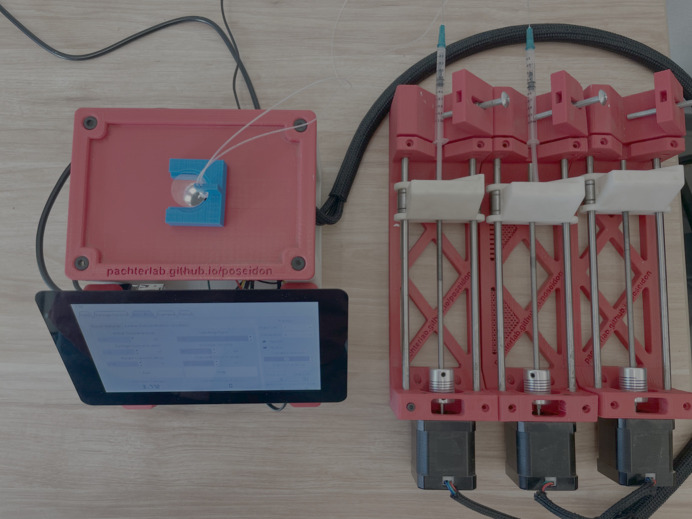
The FloBuzz team adapted Poseidon for one subsystem: the pump that delivered food to free-flying bees during repeated outdoor trials. The adaptation gave the team a controlled way to supply food in its behavioral experiments. The use is of the feeder pump, not the entire instrument.
Ismail and colleagues selected four metrics from the coauthored package selection and versioning study to compare Truecell with Seurat across three datasets. They plotted the earlier study’s results alongside their own for context. That reused the evaluation design, not the earlier code or experimental protocol.
The Malva team ran the kallisto/bustools workflow, reported as v0.28.2, as an alignment-based comparator in indexing and preprocessing benchmarks. That gave the authors a comparison with a conventional workflow; Malva’s own large-index sizes and throughput figures are not kallisto/bustools results.
Sherin and colleagues used lr-kallisto to quantify isoform expression from long reads in a comparative guppy study. The preprint reports 84 guppies sampled in 24 tissue pools across gonad and tail muscle. The tool supplied expression estimates for the comparison; the downstream study interpreted what those differences meant.
nf-core/scrnaseq 4.2.0 includes the kb workflow as an optional quantification branch. The integration handles both reference preparation and counting within the same pipeline, so teams can choose it without wiring a separate workflow. It is an option, not the default for the checked release.
Dynamo merged pflog1ppf on June 30, 2026, as an optional way to normalize the main expression matrix using proportional fitting, a log transform, and a second proportional-fitting step. Its development tutorial runs the recipe on one zebrafish dataset, retaining 4,167 of 4,181 cells after preprocessing. This is a merged integration and worked example, not a verified stable release or evidence of user uptake. It is distinct from the later shifted CLR in Scanpy.
The TissueFormer team used 406,187 cells from the coauthored Yao et al. motor-cortex atlas in an approximately 3.5 million-cell mouse pretraining corpus. The resulting Murine Geneformer model supplied TissueFormer’s single-cell component. The atlas count describes training data, not supervised test data or model performance.
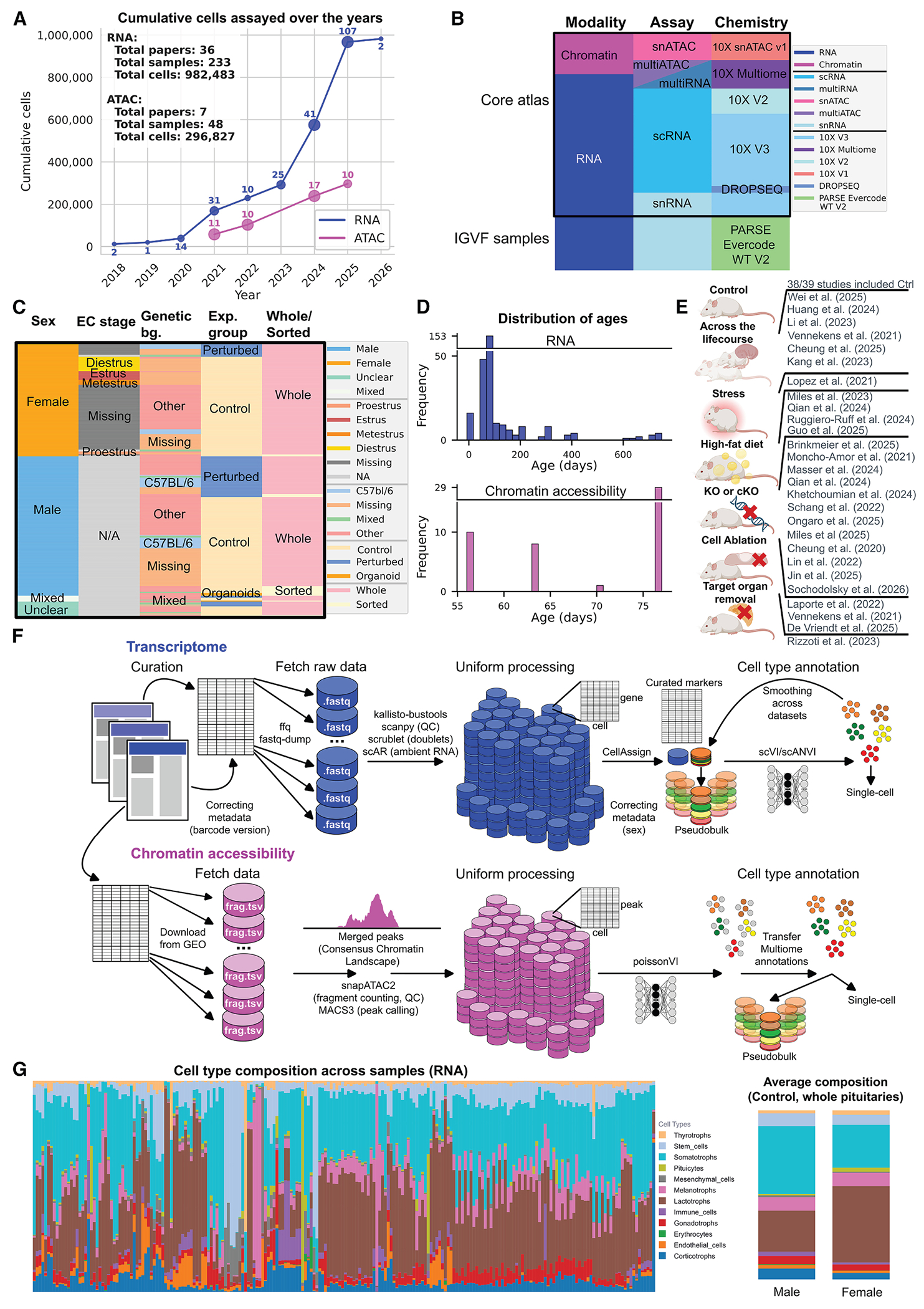
The Consensus Pituitary Atlas team used ffq 0.3.1 with SRA Tools to obtain public RNA-seq inputs before harmonizing them. Some files were obtained manually from ArrayExpress, and the separate IGVF contribution was supplied as processed matrices. The authors do not report a count for ffq alone.
The Consensus Pituitary Atlas team used kb-python 0.29.5 to preprocess the raw transcriptomic reads it obtained with a common workflow. This standardized how those RNA datasets were quantified before integration. The team used different processing for chromatin and reused the already-processed IGVF matrices.
The Consensus Pituitary Atlas team used the mx filter to distinguish signal from cell-free droplets during quality control. The authors used a fallback threshold for some datasets, so mx supported the filtering step but did not by itself determine which cell types were present.
Kövér and colleagues reused processed data and existing cell labels from the coauthored IGVF atlas to help build the Consensus Pituitary Atlas, a reference for identifying cell types in new samples. After quality control, they retained 128,315 cells from 57 datasets—about one in ten of the 1,278,316 cells in the finished reference.
Read moreRead lessPanel B shows the IGVF datasets among the inputs to the finished atlas. Kövér et al., Fig. 1 · CC BY 4.0
The leukemia study used kallisto 0.48.0 and bustools 0.41.0 with kITE’s feature-mapping script to count antibody-derived tags. The assay was run on nine of 12 specimens in the second cohort; that is the assay scope, not an audited number of successful protein-tag quantifications. RNA and chromatin were processed separately with Cell Ranger ARC.
IGVF adopted seqspec, which it co-developed, as its first formal data standard in active use. The consortium says every submission includes a seqspec file and reports its use across thousands of submitted datasets without giving an exact total. Its single-cell workflow can read the specification to interpret the structure of reads and barcodes.
ReviewBench reused the manuscript text and human peer reviews for 1,000 eLife papers from OpenEval to build a benchmark for studying review quality. The team ran its own assessment pipeline; what traveled from OpenEval was the corpus, not its model judgments.
Rathgeber and colleagues used kallisto 0.50.1 and bustools 0.43.2 to turn TotalSeq-A reads into antibody-feature count matrices. They analyzed those matrices in Seurat and custom R scripts to study the transition from monoclonal B-cell lymphocytosis to chronic lymphocytic leukemia. This use is documented for the protein tags; the methods do not give a separate count of samples or cells processed by these tools.
The Bioconductor spatial-transcriptomics textbook uses Voyager on one public human breast-tumor section. Its examples walk readers through identifying pairs of genes with similar spatial patterns and visualizing those patterns in the tissue. The example can be rerun from the book.
Wissel and colleagues benchmarked five tools using depth-matched PacBio Kinnex datasets. In that comparison, lr-kallisto and Oarfish stood out on runtime and memory. The measurement excluded alignment and index building, and the authors recommended Oarfish overall for their data.
The SECreTour team drew on the machine-readable science approach for a heritage prototype. Its pilot produced 21 candidate claims in four groups from one five-page archaeology report. That is an example of method transfer into another field, not use of OpenEval’s released software or validation of every candidate.
The PODER team used lr-kallisto 0.51.1 with kb-python 0.28.2 to quantify transcript expression from long reads. The study profiled 43 lymphoblastoid cell-line samples from eight populations and generated over 800 million full-length reads. These numbers describe the study’s samples and sequencing, not a software throughput measurement.
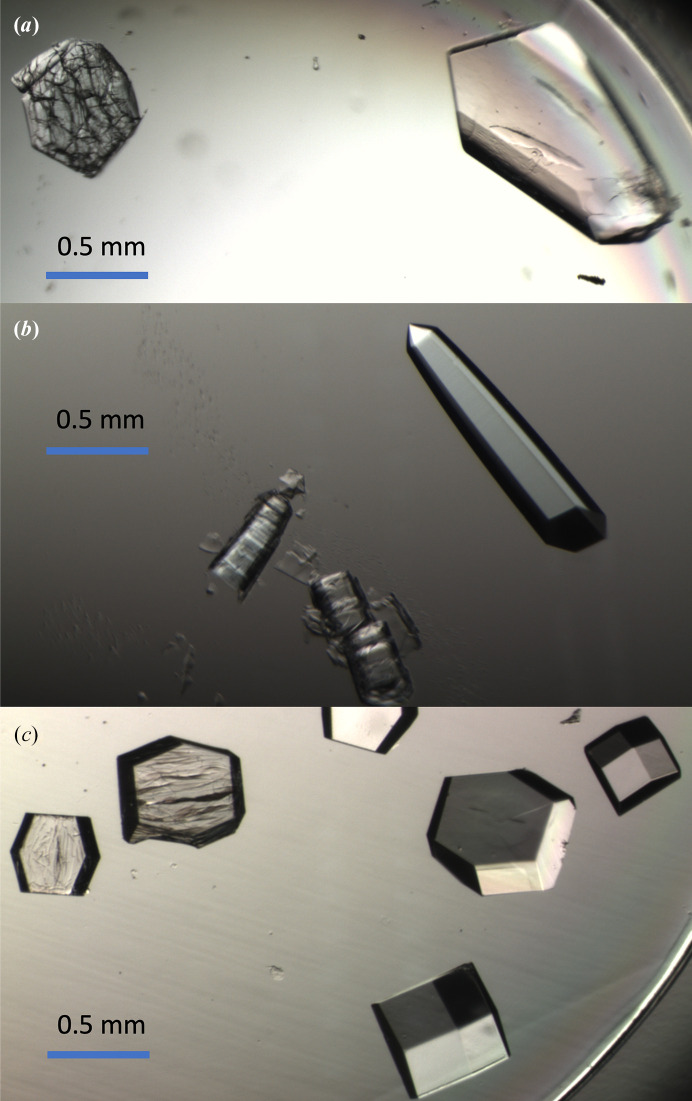
Whitman College researchers adapted Poseidon’s controls to gradually change the liquid surrounding fragile protein crystals. Using a rig with three Poseidon pumps, they tested three crystal systems and determined a room-temperature structure of α-lactalbumin at 2.2 Å resolution after a gradual exchange.
Podda and colleagues used ffq 0.2.1 to identify SRA records and retrieve metadata for the public inputs to IsoWorm’s BRAF analysis. The input pool included 690 cancer cell lines across 12 cancer types and 762 tissue samples across nine GEO datasets. Those are source-data counts; IsoWorm, not ffq, did the isoform quantification.
Golden, Wu, and colleagues used data from the Human Pancreas Analysis Program and adapted kITE to count antibody tags and sample hashtags. The resulting matrices supported sample assignment and immune-cell annotation across lymphatic tissues. The published CITE-seq dataset contained 650,704 cells after quality control from 18 organ donors: six without diabetes, five autoantibody-positive without diabetes, and seven with type 1 diabetes. That is the dataset size, not a count of successful kITE assignments. Cell Ranger processed the RNA.
Kint and colleagues used Voyager to detect local and global spatial patterns in gene-activity scores in glioblastoma tissue. Their cohort covered 28 resections from 24 patients, and Voyager’s spatial analysis examined the 1,000 most variable genes. It helped the team identify genes whose activity clustered in particular tumor regions.
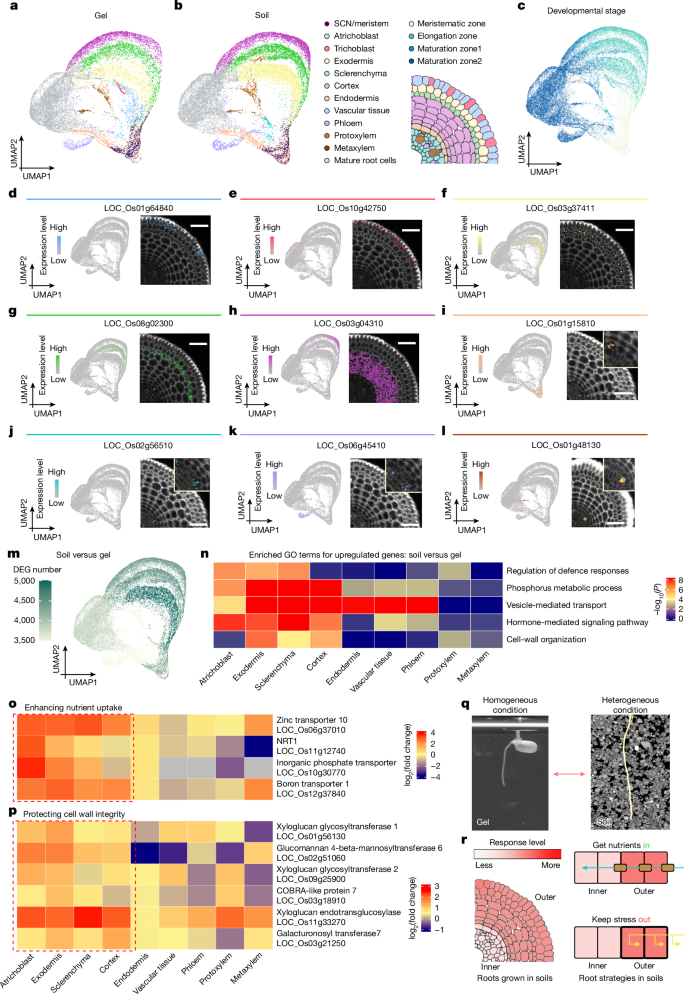
Zhu and colleagues used kallisto/bustools through scKB and COPILOT to process the rice root single-cell data. The integrated atlas contained more than 79,000 high-quality cells. One comparison plotted 21,356 gel-grown and 27,744 soil-grown root cells to show how cell populations and expression differ across growing conditions.
Read moreRead lessPanels a–b show the gel-grown and soil-grown rice root cells described above. Zhu et al., Fig. 2 · CC BY 4.0
Agrawal and colleagues reused a single-cell RNA-seq reference from the NeMO Archive to test NiCo’s spatial cell-type annotation. The reference had 71,183 cells and 20 retained subclass labels. The separate query was one MERFISH tissue section with 7,626 cells. The atlas supplied known cell-type labels for the test; the query size and NiCo’s performance are not attributable to the atlas.
Taylor and colleagues used their previously developed scKB workflow, built on kallisto/bustools, to generate count matrices for an Arabidopsis floral abscission study. The reported post-preprocessing yields total 40,666 cells across eight samples. This was a new biological application by researchers who overlapped with the scKB team.
Bhat and colleagues used kb-python 0.28.0, kallisto 0.50.0, and bustools 0.43.0 to reprocess one published mouse C2C12 SPLiT-seq dataset, GSE168776. The reanalysis was part of their investigation of the relationship between nuclear organization and mRNA splicing; it was not the preprocessing workflow for every experiment in the paper.
The intestinal zonation team used kallisto/bustools 0.46.2 to process single-cell reads for one of the two human donors. That donor contributed 29 recovered segments to the study’s subsequent comparisons along the intestinal tract. The software provided count data for part of the atlas; the biological zones are a whole-study finding.
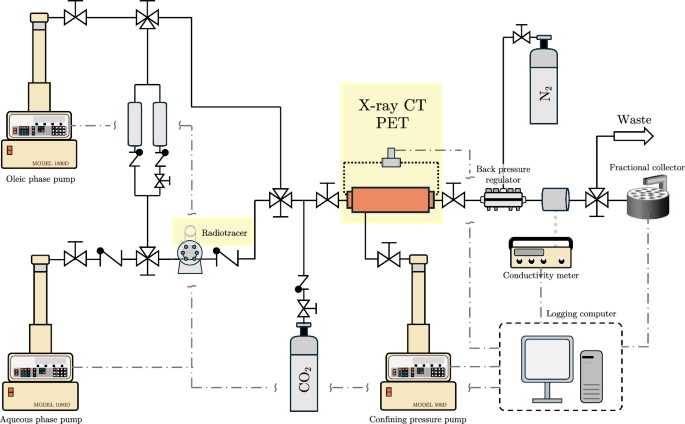
Researchers at Imperial College London and BP built a collector based on Colosseum to sample the liquid leaving sandstone cores during oil-displacement experiments. Two peer-reviewed papers from the same team document the use. The collector let them sample what came out of the rock while imaging tracked what happened inside.
Read moreRead lessThe downstream team’s schematic shows where the collector sits in the rock-flow setup. Rovelli et al., Fig. 3 · CC BY 4.0
Seq2science packages kb-python as the transcript-quantification step in its single-cell workflow, with a separate route for antibody tags. It produces count matrices that researchers can take directly into analysis tools such as Seurat or Scanpy.
In a comparison of 22 single-cell RNA-seq transformations, Ahlmann-Eltze and Huber tested a shifted logarithm with the additional per-cell rescaling proposed in the early normalization preprint. Under their settings, that step did not improve nearest-neighbor recall. The PFlog team’s later preprint reports a corrected reanalysis. This was a critical benchmark of the earlier proposal, not an endorsement or a test of Scanpy’s later shifted CLR.
Gustafsson and colleagues reused the coauthored atlas’s cortical gene-expression data and cell labels to model metabolic differences among 17 neuron subtypes, each with more than 450 cells. They built 1,700 bootstrap metabolic models from those data. The atlas supplied the input profiles and labels; the metabolic predictions came from the downstream models.
The 2023 preprint on age- and sex-associated gene expression used ffq to retrieve SRA sample accessions and metadata for public RNA-seq studies. Those records gave the team identifiers for manually reconciling sample annotations across studies. The study’s microarray data came through a different path.
KARAJ uses ffq to translate accession numbers into download locations. The paper names five repositories in this context: SRA, GEO, DDBJ, ENA, and ENCODE. That lets KARAJ handle several accession types without crediting ffq for the subsequent file transfers or download benchmarks.
Hsu and colleagues wrapped kallisto and bustools in scKB so their COPILOT workflow could generate two types of counts—spliced and unspliced RNA—and pass them into quality control. The published wrapper makes that step reusable in other plant single-cell projects.
Rode, Buus, and colleagues used kITE with kallisto/bustools to count sample hashtags and surface-antibody tags while studying GLP-1 receptor expression. Their induced regulatory T-cell run included three donors. Hashsolo assigned cells to samples after tag quantification; kallisto/bustools handled the receptor-enriched libraries separately.
nf-core packages ffq as a Nextflow module. A workflow can pass it a public sequencing accession and reuse the returned metadata and download locations, rather than implementing database lookup itself. The published module documents availability, not how many pipelines ran it.
Seqera Labs built a wrapper that exposed ffq’s metadata lookup through a web API instead of requiring clients to run the command-line tool. The repository was archived on October 13, 2025, so this is a documented past integration rather than a claim that the service still operates.
The Cell Type Knowledge Explorer, developed with the BRAIN Initiative Cell Census Network, makes coauthored atlas data available for three species: mouse, marmoset, and human. Researchers can compare cell types and use linked tools to interpret their own experiments against curated references. This is a consortium application.
Researchers at the University of Johannesburg used four 3D-printed Poseidon syringe pumps in a working flow system that prepared samples for fatty-acid analysis. They reported samples from five types of edible oil, including avocado, canola, and extra-virgin olive oil.
Shahan, Hsu, and colleagues used kallisto 0.46.2 and bustools 0.40.0 through scKB to generate spliced and unspliced counts for their root study. The completed atlas integrated 110,427 cells, including previously published data, to trace how root cell types develop. That is the size of the integrated atlas, not a count of tool runs.
Yue You and colleagues evaluated kallisto/bustools as one of 10 end-to-end preprocessing workflows across plate- and droplet-based datasets. Running it as a peer comparator revealed protocol-specific trade-offs: the tested version recovered fewer genes in a plate-based comparison, while its behavior differed on droplet data.
Shainer and Stemmer ran kb-python 0.24.4 and compared its output with Cell Ranger across 22 public single-cell datasets from eight organisms. The comparison let them test how the upstream choice affected clustering and cell-type identification in a range of tissues rather than a single reference dataset.
The coauthored SwabSeq platform was deployed by UCLA’s clinical lab. The original report describes 80,000 tests in under two months, and UCLA later reported 2 million tests processed by the lab. Those milestones describe the same ongoing deployment and count tests, not unique people.
The overlapping Poseidon and Colosseum team adapted Poseidon’s control software for a different kind of instrument: a fraction collector that fills tubes in sequence. The Colosseum prototype holds 88 tubes and reports $67.02 in parts. Those are specifications of the original prototype, not an outside lab’s costs or capacity.
Gao and colleagues used the BRAIN Initiative Cell Census Network’s mouse motor-cortex data to show how online iNMF could integrate datasets one at a time. The collection included eight datasets across four modalities and 786,605 cells; the main integration used 408,885 neurons. Joshua D. Welch coauthored both papers, so this is reuse with coauthor overlap.
The Satija Lab’s Azimuth reference harmonized data from 12 mice in the coauthored primary motor-cortex atlas. The resulting 159,738-nucleus reference lets researchers map new mouse cortex profiles against a shared set of annotated cell classes, subclasses, and clusters.
Rogosic and colleagues at Maastricht University incorporated Poseidon-based pumps into a modular science kit with three classroom-oriented activities. The pumps supply flow to the kit’s experimental hardware, giving students a way to work with flow chemistry hands-on. The paper documents the teaching kit, not gains in learning.
Gehring and colleagues demonstrated a 96-plex experiment using their kITE workflow to separate pooled samples for single-cell analysis. The paper credits Sina Booeshaghi and Páll Melsted with developing kallisto/bustools functions used in preprocessing, and Jase Gehring with developing the study’s kITE demultiplexing workflow. This is a named contribution with collaborator overlap, not independent adoption of the later kITE paper.